
Ideas from the Salt #1
When your brand is two moodboards that don't agree
I got back into surfing this summer. Properly, head over heels back in love with it.
Being a designer, I can't do anything without noticing colour, style and how things fit together, so when I bought a wetsuit, I thought about it more than the average beginner probably does. I'd rather rent a board than rent a wetsuit that many others have peed in, so the wetsuit came first, and I went for something with a bit more colour to it. I assumed I'd land on a plain white board eventually, something that would let the wetsuit do the talking.
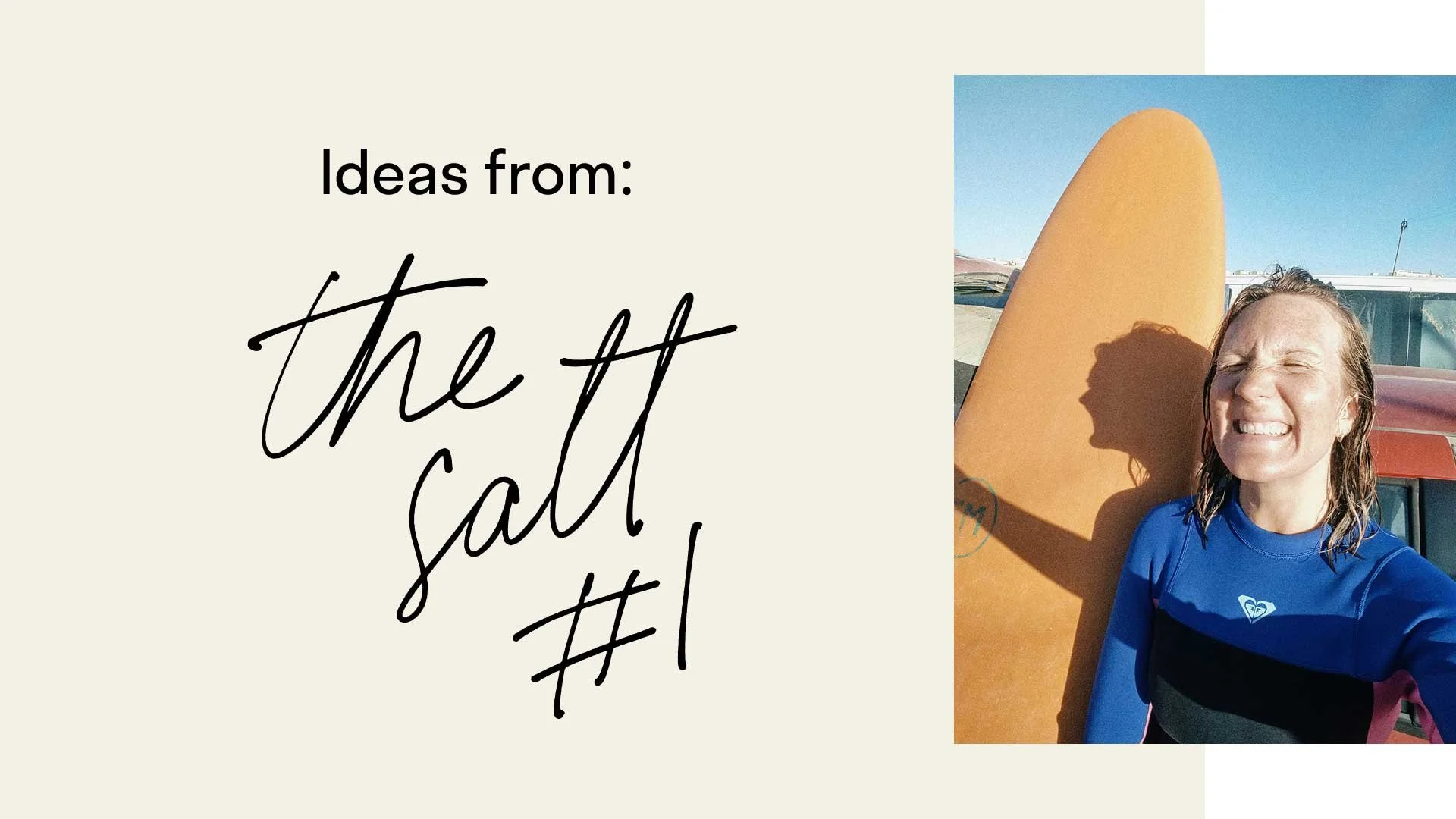
Then the perfect board came up on Facebook Marketplace. Bright orange.
I laughed, because of course it doesn't match. And of course it doesn't need to. A board and a wetsuit don't have to belong to the same aesthetic universe for either of them to work. But there's a small, persistent part of my designer brain that has to do a bit of mental gymnastics to let that go. So, naturally, I made moodboards. One for the board, one for the wetsuit.

The board's moodboard turned out warm and sun-bleached: mustard, terracotta, cream, that sunny, surf-club, "seaborn club" kind of feel, the sort of palette that belongs on a hand-painted sign outside a beach shack. The wetsuit's moodboard is almost the opposite: cool purples, hot pink, electric blue, more neon dusk than golden hour, closer to a sunset filter than a surf shop.
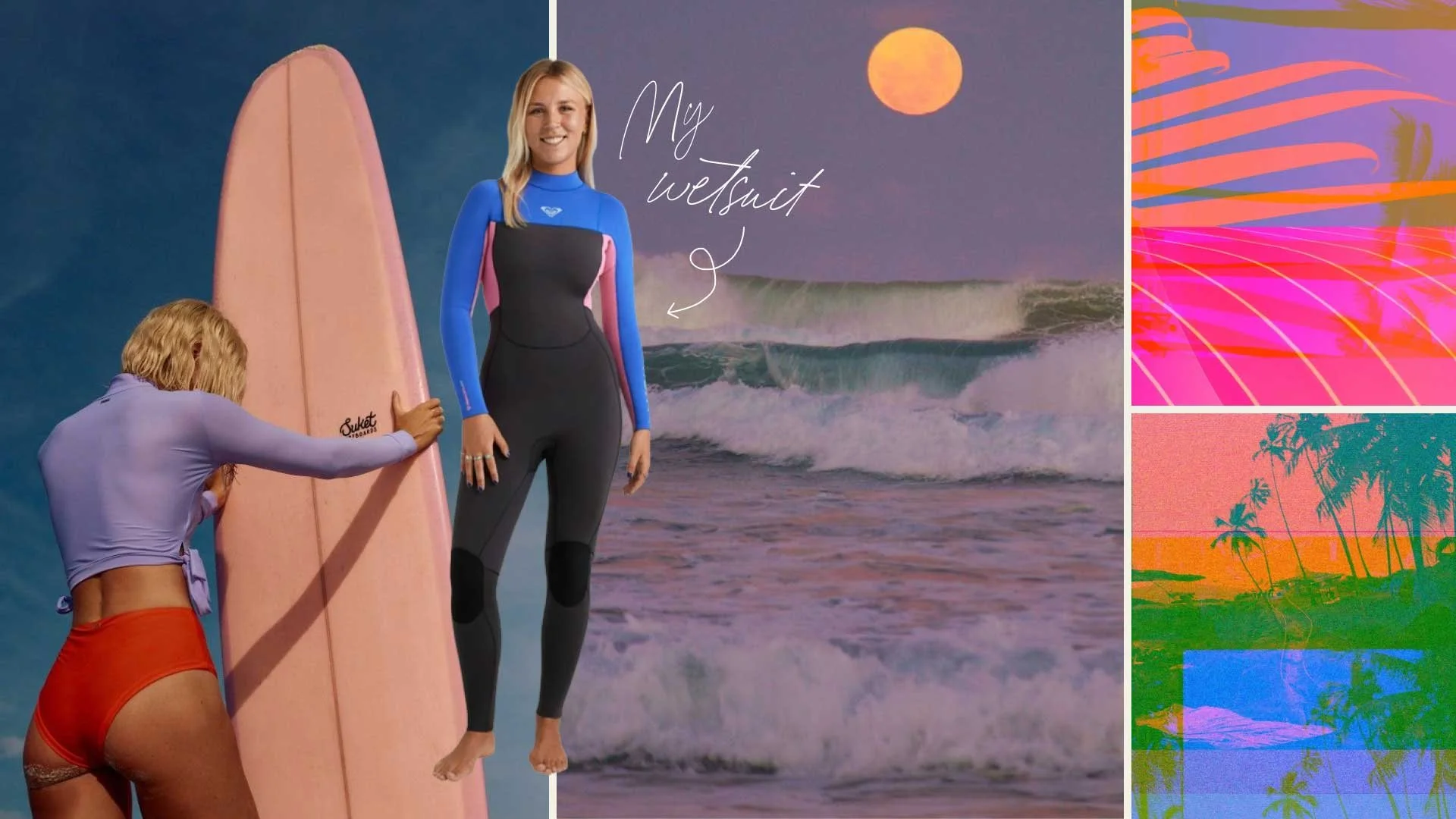
Both genuinely nice on their own. Put them side by side, though, and they're clearly not the same brand. Nobody would sit down and choose both directions on purpose. And yet here I am, owning both of them, using both of them, happily, in the sea, at the same time.
Why "close enough" creeps in
If you're building a personal or business brand without much of a plan, this is usually how it goes wrong. Not through bad taste, but through too much of it.
The person shaping your aesthetic, even if that's you, probably has good instincts. That's rarely the problem. The problem is being drawn to lots of beautiful, shiny things without a fixed idea of what the brand actually is. Without that anchor, you end up saying yes to whatever's pulling you in that particular week. A mustard-and-terracotta week. Then, a few months later, a neon-dusk one. Each choice feels fine at the time, because it is fine, in isolation. Two good decisions made independently just don't automatically add up to one coherent brand.
Two good decisions, made independently, don't automatically add up to one coherent brand.
How it shows up over time
I see this pattern constantly in brands that have muddled through rather than been steered. Nobody sits down and decides to make things messy on purpose. It happens gradually, and usually invisibly, in this order:
There was a vision at some point, maybe from proper professional branding, or at least real thought you put in yourself when you started out.
New directions keep pulling at it. A trend worth trying. A competitor doing something that looks good. A new hire with their own taste. A rebrand that got half-finished and then quietly abandoned.
Each individual choice feels reasonable when you make it. Nobody is being careless. You're just responding to what's in front of you.
A few years on, nothing quite holds together, and it's genuinely hard to point to the moment it started drifting, because there wasn't one moment. There were dozens of small, sensible-seeming ones.
The fix isn't more taste, it's a decision
Clearly an orange board paired with a blue / pink wetsuit is a non-event; mildly frustrating at most. Nobody's business depends on my surf gear matching.
But a brand that's drifted for a few years is a considerably more expensive version. It shows up as inconsistent messaging across channels, a website that looks like it was built in three different eras, or customers who, if you asked them, couldn't quite describe what you actually stand for.
The way out isn't finding better inspiration. More good taste doesn't fix this, because good taste was never the problem. It's deciding, concretely and in writing if you can manage it, what the brand actually is. And then having the discipline to say no to the things that don't fit, however good they look on their own, and however tempting the next shiny moodboard is.
Does it matter if my surfboard and wetsuit match? Of course not.
But if your brand looks like two different moodboards mashed together? That's something worth thinking about.